

Alkaline Water Electrolysis Market to Reach USD 35.14 Billion by 2035, Driven by Green Hydrogen Demand
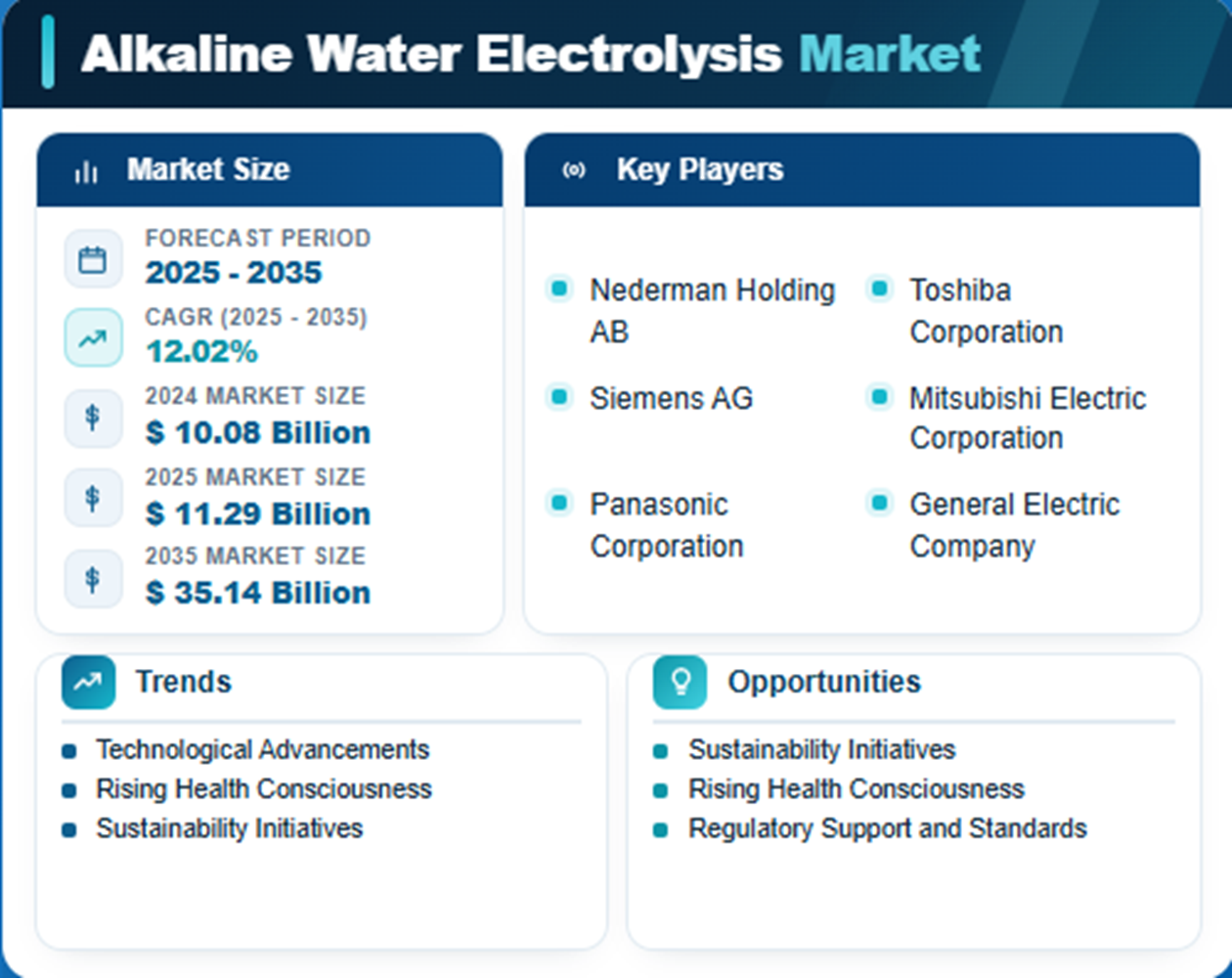
Alkaline Water Electrolysis Market Size
Asia-Pacific is emerging as the fastest-growing region, reflecting a rising demand for functional beverages and sustainable solutions.
The Alkaline Water Electrolysis Market is currently experiencing a notable transformation, driven by increasing consumer awareness regarding health benefits associated with alkaline water. ”
NEW YORK, NY, UNITED STATES, September 9, 2026 /EINPresswire.com/ -- As per Market Research Future analysis, the Alkaline Water Electrolysis Market Size was estimated at 10.08 USD Billion in 2024. The Alkaline Water Electrolysis industry is projected to grow from 11.29 USD Billion in 2025 to 35.14 USD Billion by 2035, exhibiting a compound annual growth rate (CAGR) of 12.02% during the forecast period 2025 - 2035. This growth is anchored in the global push for hydrogen production, with alkaline water electrolysis (AWE) emerging as a mature and cost-effective technology for large-scale hydrogen generation, driven by ambitious government targets and falling renewable energy costs.— Anshula Mandaokar
Market Overview
Alkaline water electrolysis is a well-established electrochemical technology that uses electricity to split water into hydrogen and oxygen in an alkaline electrolyte solution (typically potassium hydroxide). It is one of the most mature and commercially deployed electrolysis technologies, valued for its durability, long operational life, and ability to be scaled to multi-megawatt capacities. The market is primarily segmented by product type (solid, liquid, and anion exchange membrane), capacity, application (hydrogen production, industrial, power generation, transportation), and end-user (energy companies, chemical companies, industrial gas companies, etc.).
The market is experiencing strong growth driven by several key factors. The global push for decarbonization and the adoption of national hydrogen strategies in over 40 countries are creating massive demand for electrolysis capacity. The falling cost of renewable electricity (solar, wind) is making green hydrogen production more economically viable, enhancing the business case for AWE plants. AWE technology is particularly suited for large-scale, grid-connected hydrogen production due to its maturity, scalability, and lower capital costs compared to PEM electrolysis for high-volume applications. Government incentives, subsidies, and regulatory targets for green hydrogen are providing critical financial support and market certainty. Technological advancements are improving efficiency, reducing energy consumption, and lowering operational costs.
Industry trends indicate a decisive shift toward larger, more efficient electrolyzer systems. The capacity of new AWE plants is increasing, moving toward 5-20 MW and above systems to capture economies of scale. Innovations in electrode materials, separators, and cell design are improving current density and reducing stack degradation. The integration of AWE with renewable energy sources like solar and wind for direct hydrogen production is becoming more common. There is growing adoption of modular electrolyzer designs for easier scalability and deployment. Partnerships between energy companies, utilities, and technology providers are accelerating project development.
Technological developments are reshaping the market landscape. Solid alkaline water electrolyzers, using a solid polymer electrolyte, are a key growth area offering potential for higher efficiency and compact design. Anion Exchange Membrane (AEM) electrolyzers are emerging as the fastest-growing segment, combining the benefits of alkaline (non-precious metal catalysts) with the operational advantages of membrane-based systems. Advanced catalysts and electrode structures are improving efficiency and durability. Innovations in system design are enabling faster response times and better dynamic operation to match variable renewable power. Digitalization and AI are being integrated for predictive maintenance and operational optimization.
Policy and regulatory influence continues to shape market dynamics. National hydrogen strategies (e.g., U.S. DOE Hydrogen Energy Earthshot, EU REPowerEU) are setting production targets and mobilizing funding. Financial incentives like tax credits (e.g., U.S. 45V), feed-in tariffs, and carbon pricing mechanisms are improving project economics. Emission reduction mandates and the use of green hydrogen in refining, chemicals, and transport are being mandated. Support for research, development, and demonstration projects is accelerating technological innovation and cost reduction. The Carbon Border Adjustment Mechanism (CBAM) and other trade policies are adding momentum.
North America is the largest market, driven by strong policy support, technology innovation, and significant investments in hydrogen infrastructure. Asia-Pacific is the fastest-growing region, led by China, Japan, and South Korea's ambitious hydrogen roadmaps and large-scale deployment plans.
Get Free Sample Report for Detailed Market Insights:
https://www.marketresearchfuture.com/sample_request/25663
Market Segmentation
By Product Type
Solid Alkaline Water Electrolyzers: The largest segment, dominating the market with approximately 40-45% share. Proven technology widely used in large-scale industrial applications, characterized by robust design and high reliability. Solid AWE systems offer a stable and efficient solution for high-volume hydrogen production.
Anion Exchange Membrane Alkaline Water Electrolyzers: The fastest-growing segment, driven by the demand for clean energy solutions and lower operational costs. Emerging technology that combines the benefits of alkaline (low-cost materials) with membrane-based operational advantages. Projected to reach significant valuation by 2035.
Liquid Alkaline Water Electrolyzers: A mature and niche segment, representing a smaller but significant share. Offers proven performance and cost-effectiveness for specific applications where liquid electrolyte systems are preferred.
By Capacity
1-5 MW: The largest segment, holding the majority share due to its widespread application in industrial settings and energy generation. Benefits from established technology and infrastructure, offering a balance of scalability and efficiency.
5-20 MW: The fastest-growing segment, driven by increasing investments in larger electrolysis systems to meet rising energy demands and sustainability goals. Captures economies of scale, fueled by technological advancements and governmental support for hydrogen initiatives.
Below 1 MW: Serves smaller-scale distributed applications and pilot projects.
Above 20 MW: Emerging segment for gigafactory-scale hydrogen production hubs.
By Application
Hydrogen Production: The largest segment, significantly leading the market share due to its essential role in producing high-purity hydrogen for industrial applications (refining, chemicals, metals). Dominant segment due to its multifaceted use in chemical manufacturing, oil refining, and metal processing.
Power Generation: The fastest-growing segment, emerging with greater emphasis on renewable energy solutions. The integration of AWE with renewable energy sources for grid balancing and long-duration energy storage is key.
Industrial Applications: A significant segment using hydrogen as a feedstock or energy source.
Transportation: Emerging segment leveraging AWE for hydrogen refueling stations for fuel-cell electric vehicles, particularly heavy-duty transport.
By End User
Energy Companies: The largest end-user segment, holding a substantial share due to the rising demand for hydrogen as a clean energy source. Leveraging AWE technology to produce hydrogen efficiently, driven by the global emphasis on reducing carbon emissions and shifting to cleaner fuel alternatives.
Chemical Companies: The fastest-growing segment, integrating AWE into production processes to maintain competitiveness and adhere to stringent environmental standards. Shifting towards a circular economy and enhancing sustainability in chemical processes.
Industrial Gas Companies: Major producers and distributors of hydrogen.
Government Agencies: Supporting hydrogen infrastructure and demonstration projects.
Transportation Companies: Adopting hydrogen for fuel-cell vehicle fleets.
You can buy this market report at:
https://www.marketresearchfuture.com/checkout?currency=one_user-USD&report_id=25663
Regional Analysis
North America
North America is the largest market, holding approximately 40% of the global market share. The U.S. is a major contributor, driven by the DOE's Hydrogen Energy Earthshot initiative (targeting $1/kg hydrogen cost), the 45V tax credit for clean hydrogen production, and significant investments in regional hydrogen hubs. Canada is also supporting growth through its national hydrogen strategy. The competitive landscape features major players like General Electric and Honeywell, alongside innovative startups, and benefits from advanced research institutions.
Europe
Europe is the second-largest market, accounting for around 30% of the global share. Growth is fueled by the EU's ambitious climate goals, the REPowerEU plan targeting 10 million tonnes of domestic green hydrogen production by 2030, and the European Green Deal. Germany leads in electrolyzer manufacturing and deployment, with France and the Netherlands also significant. Siemens and Schneider Electric are key players. The region's strong regulatory push and focus on sustainability make it a hub for innovation.
Asia-Pacific
Asia-Pacific is the fastest-growing region, holding approximately 25% of the global share. China is aggressively pursuing green hydrogen to decarbonize its industrial sector, leading in installed electrolysis capacity. Japan and South Korea are advancing their hydrogen roadmaps for energy security and transport, with companies like Toshiba and Mitsubishi Electric leading. Government initiatives and investments are propelling market expansion.
Middle East & Africa
The Middle East & Africa region holds about 5% of the global share but offers significant potential. Driven by abundant solar resources and interest in diversifying energy exports, Saudi Arabia is investing in green hydrogen projects (e.g., NEOM) to become a leading exporter. South Africa is also exploring the potential. The competitive landscape is developing, with early-stage projects and government support.
Competitive Landscape / Key Players
The market is characterized by a dynamic competitive landscape, driven by increasing demand and technological advancements. Key players are strategically positioning themselves through innovation and partnerships. The market appears moderately fragmented, with a mix of established industrial conglomerates and specialized electrolyzer manufacturers.
Siemens AG (Germany): Focuses on enhancing product offerings through digital transformation and strategic partnerships. In August 2025, announced a strategic partnership with a leading renewable energy firm to develop integrated AWE-solar solutions.
Panasonic Corporation (Japan): Emphasizes regional expansion to capture emerging markets and unveiled a new line of residential alkaline water electrolyzers in September 2025, targeting home-based hydrogen production.
General Electric Company (US): Leverages extensive experience in energy solutions to integrate AWE technology into broader energy systems. Launched a pilot project in July 2025 with a major utility to test integration into existing grids.
Toshiba Corporation (Japan): Strong presence in the Asia-Pacific region, focusing on large-scale hydrogen production systems.
Nederman Holding AB (Sweden): Specializes in industrial air filtration and environmental technology.
Other notable players include Mitsubishi Electric, Honeywell, Emerson Electric, and Schneider Electric.
Latest Industry News & Developments
Q2 2025: Thyssenkrupp Nucera and De Nora expand water electrolysis manufacturing capacity, enabling production of electrolysis cells with a total power consumption of one gigawatt annually.
Q2 2025: Nel ASA secures a contract to deliver alkaline water electrolyzers for a major green hydrogen project in Europe, marking a significant step in scaling up production capacity.
Q2 2025: Cummins opens a new hydrogen electrolyzer manufacturing facility in Belgium to meet growing demand for green hydrogen in Europe.
Q2 2025: Thyssenkrupp Nucera signs a strategic partnership with Saudi Aramco to deploy alkaline water electrolyzers for large-scale hydrogen production in Saudi Arabia.
Q1 2025: Green Hydrogen Systems secures Series B funding to scale alkaline electrolyzer production, supporting increased demand for green hydrogen projects.
Market Challenges & Opportunities
Key Restraints
High initial capital costs for large-scale electrolysis systems remain a barrier. The intermittency of renewable energy sources requires AWE systems to be capable of dynamic operation, adding complexity. Scaling up manufacturing capacity to meet projected demand is a challenge. Competition from PEM electrolysis and other hydrogen production methods (e.g., methane pyrolysis) is intensifying.
Emerging Opportunities
Expansion into emerging markets with abundant renewable energy resources (e.g., Middle East, Australia). Development of modular and containerized AWE systems for easier deployment and scalability. Advancements in AEM technology and electrode materials are improving efficiency and reducing costs. Integration of AWE with energy storage systems for grid balancing and backup power. Co-location of electrolysis with industrial clusters to utilize waste heat and oxygen.
Future Potential
The global green hydrogen market is projected to reach over USD 1 trillion by 2050, creating immense opportunities for AWE as a core production technology. The cost of AWE systems is expected to continue declining with manufacturing scale and innovation. New applications in e-fuels (methanol, ammonia, synthetic fuels) will create additional demand. Strong policy support and carbon pricing mechanisms globally will sustain long-term growth. Digitalization and AI will optimize operations and lower costs, enhancing competitiveness.
To explore more market insights, visit us at:
https://www.marketresearchfuture.com/reports/alkaline-water-electrolysis-market-25663
Final Market Summary
The global Alkaline Water Electrolysis Market is poised for strong growth, with projections indicating expansion from USD 11.29 Billion in 2025 to USD 35.14 Billion by 2035, registering a 12.02% CAGR. Market dynamics are driven by the global push for green hydrogen production, falling renewable energy costs, and supportive government policies. The shift toward larger, more efficient systems and the emergence of new technologies like AEM electrolyzers is transforming the market landscape.
North America holds the largest market share at approximately 40%, driven by strong policy support and investment, while Asia-Pacific is the fastest-growing region, led by China, Japan, and South Korea. Europe follows with 30% share, supported by ambitious climate goals. While challenges including high capital costs and scalability remain, the long-term industry outlook remains exceptionally robust, supported by the essential role of AWE in enabling large-scale, cost-effective green hydrogen production for industrial decarbonization, energy storage, and the broader energy transition. The decade ahead will reward players who invest in scaling manufacturing, advancing materials science, and integrating with renewable energy and digital systems.
More Related Reports from MRFR Library:
liquefied petroleum gas lpg Market: https://www.marketresearchfuture.com/reports/liquefied-petroleum-gas-lpg-market-11766
fuel cell technology Market: https://www.marketresearchfuture.com/reports/fuel-cell-technology-market-798
double diaphragm pumps Market: https://www.marketresearchfuture.com/reports/double-diaphragm-pumps-market-887
air operated double diaphragm pumps Market: https://www.marketresearchfuture.com/reports/air-operated-double-diaphragm-pumps-market-891
high voltage cables accessories Market: https://www.marketresearchfuture.com/reports/high-voltage-cables-accessories-market-908
protective relay Market: https://www.marketresearchfuture.com/reports/protective-relay-market-918
circuit breaker Market: https://www.marketresearchfuture.com/reports/circuit-breaker-market-921
substation batteries Market: https://www.marketresearchfuture.com/reports/substation-batteries-market-933
global artificial lift Market: https://www.marketresearchfuture.com/reports/global-artificial-lift-market-961
air handling units Market: https://www.marketresearchfuture.com/reports/air-handling-units-market-962
Market Research Future
Market Research Future
+1 855-661-4441
email us here
Legal Disclaimer:
EIN Presswire provides this news content "as is" without warranty of any kind. We do not accept any responsibility or liability for the accuracy, content, images, videos, licenses, completeness, legality, or reliability of the information contained in this article. If you have any complaints or copyright issues related to this article, kindly contact the author above.
